Perth CBD Engineering Heritage Walking Tour
Welcome
Welcome to the City of Perth Engineering Heritage walking tour. This is a conducted walk, or you can follow this online tour guide and learn how engineers helped create the Perth we know today. You can start and end at any location, take as long as you like, or stop for coffee or a cool drink. Keep this page open on your phone.
This walking tour is for the CBD area. You need to open the Perth East, Perth West, Kings Park or East Perth tours to see other tours available for your interests.
We have three walks called '''Perth CBD Walking Tour''' and '''City East Extension''' and '''City West Walk'''.
You can also choose your own tour and see what sites are of interest to you.
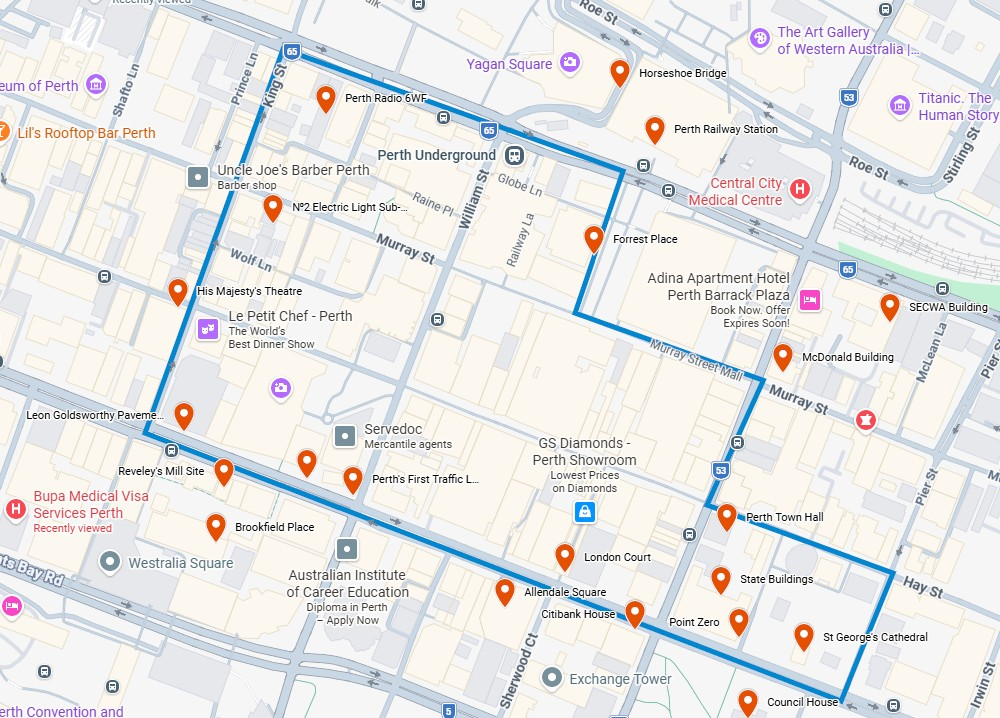
Simply click on the green arrow "directions" symbol alongside the images of each location below. This will take you to Google Maps on your phone and help guide you to the best viewing location. Wander as you like when you reach the location, then click the green arrow, the next directions symbol, to find out how to reach the next location.
About the tour
The walking tour online map contains detailed information and images about each site. It is designed for use with a tablet or larger mobile phone, and requires internet access while exploring the city.
The two main walking routes start from Point Zero, located at the corner of St Georges Terrace and Cathedral Avenue, while the East Perth extension route starts and finishes at Hill Street.
To navigate a walking route, zoom into the map to find Point Zero, marked with a symbol and decide which tour you wish to follow. Tap the coloured lines to find out more about each route. Tap the Point Zero symbol to read about this site and get directions to the next site on the route. Alternatively, tap on any individual site number to learn about that site.
Safety
While exploring, please consider your safety at all times and be especially mindful of vehicles when crossing roads and stepping back to admire the engineering works.
Additional Links
Perth CBD Walking Tour (2.4km)
Meet the engineers who built Western Australia and discover Perth’s first water supplies and modern transport marvels. Starting at Point Zero, follow the green route in an anticlockwise direction to finish at Elizabeth Quay.
No 1: Forrest Place (Perth Information Centre)

Named after Sir John Forrest, the first Premier of Western Australia, Forrest Place was for most of its history a roadway between the Perth railway station and Murray Street.

Prior to Forrest Place's construction, an arcade between Wellington and Murray Streets existed on the site known as Central Arcade. It was considered an "unhealthy" establishment, which led to its demolition. The construction of Forrest Place was deemed to have "changed the face of Perth."
The west side is dominated by the General Post Office (completed in 1923) and the Commonwealth Bank building (completed 1933), both designed in the Interwar Beaux-Arts style and faced with Donnybrook stone.
In the 1940s returned soldiers marched through Forrest Place. It was a meeting place and focal point for political meetings in the 1950s through to the 1980s; considerable use was made of the steps of the Post Office being above the roadway level.
Construction commenced in mid-1914 and initially experienced a delay due to sandy soil on the site. The subsequent outbreak of World War I led to a significant delay in the building's construction. The steel to be used in the construction became subject to an embargo by the British Government in 1916. An alternative supply was finally sourced from BHP in 1920. Construction was later delayed due to a six-month engineers' strike. The flooring and fittings were originally to be Australian blackwood however jarrah was substituted which could be locally sourced.
Over the course of construction, the design of the building had been modified several times, largely in an effort to reduce costs. In 1921 it was resolved to add a further two storeys to the top of the building for use by other Commonwealth departments. These additional storeys were to be walled with brickwork, rather than the stone used to clad the rest of the building's facade. However, the side and rear walls of the building were also of brick, and so the brick attic storey "tied in" with these treatments.
At its opening, the new General Post Office was Perth's largest building and was considered to be "by far the most ornate structure in the city.”
The Commonwealth precinct expanded with subsequent construction of the Commonwealth Bank of Australia building immediately south of the General Post Office. It was specifically designed in a similar style to the General Post Office. Another similarly styled Commonwealth department was planned for the General Post Office's northern side; but this was not constructed for many decades and did not emulate the design of the General Post Office.
Forrest Place was closed to traffic in the late 1980s. The Padbury Buildings on the eastern side of Forrest Place, which had been constructed in 1925, were demolished and the widening of Forrest Place has effectively created a town square.
The General Post Office is founded on 1,525 piles in groups of 25, each pile 9.1 m long and 36 cm in diameter. The building is constructed by a concrete-encased steel frame, faced with stone and brick. The brick walls did not receive a particularly favourable reception upon the building's opening and it was felt that they might be mistaken for the walls of a factory by anyone who had not seen the front of the building.
No 2: Perth Central Railway Station

The original Perth Central Station was designed by Richard Roach Jewell, the same architect of other famous city buildings such as Perth Town Hall, and Pensioners’ Barracks. After 10 months of construction, the station was opened for public use in 1881, along with the entirety of the Fremantle-Guildford railway line.
The station was designed with a single through platform, with bay platforms to the east and west. This design proved to be inadequate for the expanding rail network, so the decision was made to construct a new, larger station to the immediate south of the original one.
The new Perth Railway Station was designed by Government architect and engineer George Temple-Poole in the neoclassical style similar to his other works including the State Buildings near Point Zero. The new station was built in the large space between Perth Central Station and Wellington Street, allowing the old station to remain in operation throughout construction. The new building was completed by 1893 and included offices for the Western Australian Government Railways in the second level. The old Central Station was then demolished.
Perth was first linked by rail to Adelaide and Sydney in 1917 by the Trans-Australian Railway. In joining eastern and western Australia, it provided a physical link which was to be of major commercial and strategic importance and which improved immeasurably the convenience and comfort of interstate travellers. The railway was also a symbol to all Australians of the bonds which had bound the colonies together in Federation.
When the Trans-Australian Railway commenced operation, no other railway in the world was so completely self-contained. Commonwealth Railways ran its own farms and stores, and the small communities along the line had all their social and service infrastructure provisioned by rail. The railway had a number of unique operational features including the longest straight stretch of track in the world (478.2 km), and for twenty years from 1933, the longest run undertaken by coal burning steam locomotives (867 kilometres from Cook to Kalgoorlie).
No 3: Horseshoe Bridge

As the gold rush hit Western Australia in the 1890’s Perth experienced its first population and construction boom. Unconstrained growth around the central railway station saw the area develop into a “great area of yards and squalid sheds of ill-conceived contrivance”. With up to seven sets or rail tracks the area had become very difficult and dangerous to cross by horse or on foot. However, the major challenge faced by the Public Works department was that close proximity of the buildings at either side of the railway made it very problematic to construct a straight bridge.

An ingenious engineering solution to this came in 1903 with the construction of horseshoe-shaped bridge. Robert Howard, a draughtsman working for the Public Works Department, drew up plans for a horseshoe bridge. The estimated expense was originally £25,000, but it was delayed for a couple of years and eventually cost an enormous£40,000.
The completion of the bridge allowed for easier vehicular and pedestrian traffic over the tracks and reinforced William Street as one of the main access routes into Central Perth from the north. In the early 1920s, a tram line was laid over the horseshoe Bridge, connecting Osborne Park and Leederville with central Perth via Newcastle Street. The bridge has acted as a major link between the city centre and the expanding northern suburbs and remains in use.
No 4: Perth Radio 6WF (fmr Westralian Farmers Building)
In 1924, the Westralian Farmers Co-operative Limited (Wesfarmers) began operating radio station 6WF from the top floor of the company’s Wellington Street building. The first manager and chief engineer of 6WF was Wally Coxon, who has been described as "The Father of Radio in Western Australia".

The radio station comprised two studios, the smaller used for news broadcasting, the larger for music and entertainment. The studios were fitted with the latest equipment for the era, with the wall cavities filled with sawdust for soundproofing. Two massive radio towers, each weighing 3.5 tons, were located on top of the building. 6WF was initially a long-wave station with 5 kilowatts of power on 1250 metres, 240 kHz.
The station facilities were installed at a cost of approximately £12,000 and had a broadcasting capacity of 600 miles.
To gain extra coverage for 6WF programs, Wally Coxon also broadcast on the short-wave band, as these radio frequencies can reach vast distances by being refracted back to the earth by the ionosphere (a phenomenon known as “skywave propagation”). Important factors when 6WF was targeting the widely dispersed farming community.
The Australian Broadcasting Company took over five years later in 1929 and Coxon was replaced by the ABC's own engineer from Sydney.
Wally Coxon went on to later support the radio network used by the Royal Flying Doctor Service, building the 'Coxon Communicator' - an inexpensive and efficient radio used at many outposts across the State.
No 5: No.2 Electricity Substation

No. 2 Substation, Murray Street was constructed in 1914 as part of changes to the electricity system of Perth in response to its rapidly increasing population. It was one of four electricity substations constructed by Perth City Council to operate with the new East Perth Power Station (1916), the first centralised electricity supply in Perth, and continued to operate as an electricity substation into the twenty-first century.
The Perth City Council’s unwillingness to completely relinquish control of electricity production and distribution for their locality is illustrated in the physical fabric of No. 2 Substation, Murray Street, which originally featured the name Perth City Council in the entablature, despite having been built as part of a State Government centralised electricity scheme.
The erection of No. 2 Substation, Murray Street and installation of the plant was supervised by Merz & McLellan. Merz & McLellan, particularly Charles McLellan, were advisers to the City of Perth and the State Government regarding electricity production and were significant in the decision to centralise and change to alternating rather than direct current.
The initial four substations were built on a 6kV ring main with two step down transformers to 600V around the City and all still exist, though as the ring main was upgraded initally to 11kV and then to the current 22kV and with the introduction of progressively more compact technology they became progressively more redundant with #1 Wellington St being acquired by Royal Perth Hospital in 1974, #3 Colin St was disposed of in the mid 1980s, #2 being decommissioned at the same time and only #4 Palmerston St still in service.
No 6: His Majesty’s Theatre
When it opened in 1904, His Majesty’s was a four-storey ornately decorated building which combined both a hotel and theatre. When opened, it was the largest theatre in the country and had seating for over 2,500 people. It is also thought to be the first reinforced concrete building constructed in Perth.
His Majesty’s Theatre was (and remains) one of the finest Edwardian buildings to be erected in Australia.
His Majesty’s Theatre was designed by architect William Wolf (who also spelt his name Woolf). Born in New York, Wolf claimed to have trained as an architect in Germany, but recent discoveries have shown there was no architecture course at the university from which he said he graduated.
The architecture is of the Italian school. Two tiers of balconies, carried out in the Doric order, run around the whole front, while the windows on the top floor. have annexed to them balconettes, which form a happy blend with the rest of the façade. Roman columns, piers, and pilasters support the outside fabric. The main pediment bears the Royal crest, while the minor pediments, which are set in a series of segment arches, are surmounted by the models of six lions.
Unfortunately, the two tiers of balconies were removed in 1947-48, as the supporting pillars were considered a traffic hazard in that era, but are currently being restored.
The itself was an impressive space, with a stage 20 metres by 24 metres, and an auditorium of 23 metres by 21 metres, seating 2,584 people in three tiers: 974 on the ground floor, 540 in the dress circle, and a further 1,070 in the family circle and the gallery. The auditorium featured four artificial waterfalls and the dome of the roof could slide open to improve ventilation, and on warm nights the audience could sit under the stars.
After Sir John Forrest had declared His Majesty’s officially opened, the owner, Tom Molloy responded by complaining about the amount of “red tape” (such as fire regulations) with which an entrepreneur needed to comply. In fact, the opening night’s performance was nearly cancelled as compliance with several planning regulations was in doubt.
A determined public campaign in the 1980’s persuaded the State Government to buy the theatre for local performing arts companies and to restore it to its former glory. As one newspaper wrote at the time: “It’s not a case of trying to revive a dead body, it’s a matter of rejuvenating a lady who has given this city a great deal of pleasure.”
No 7: Barracks Arch
The Barracks Arch is all that remains of the former Pensioner Barracks. The Barracks was completed in 1866 and housed the Enrolled Pensioner Guard Force. This force was made up of Army veterans who joined up for six months full time service as guards on the convict ships, in return for land grants. At the end of their six months, they remained on call and had to parade a minimum of 12 days a year.
As well as dormitories, the barracks had 21 married quarters. Each family apartment had two rooms, each about 13 by 11 feet with at least one fireplace. Also on site was a separate cookhouse, firing range and gunroom, washhouse, stores and stables, and a fives (squash) court.

The Barracks were gradually converted to offices for the Public Works Department between 1900 and 1904, becoming its headquarters in 1904. Notable occupants included C. Y. O'Connor, whose office was immediately above the arch. The fives court housed the drawing office and eventually connected to a mid-1920s addition for the Metropolitan Water Supply, Sewerage and Drainage department. The Public Works Department and Metropolitan Water Board moved to Dumas House in March 1966.
The Government intended to demolish the Barracks to facilitate the building of the Mitchell Freeway after the departments moved to their new location. The Royal Western Australian Historical Society formed a Barracks Defence Council who worked to keep the arch and five bays of windows either side, and at worst, keep only the gateway and towers. Meanwhile, demolition proceeded, with the third and fourth bays of windows demolished and rubble cleared.
A number of opinion polls were conducted to gauge the public's preferences, with the Premier Sir David Brand interpreting the results as indecisive. He declared Parliament would decide on the arch's fate on a non-party basis. The motion to demolish the arch was defeated on 19 October 1966, by 26 votes to 18.
The Barracks Arch blocks the otherwise unobstructed view from Parliament House down the length of St Georges Terrace and it was intended that demolition of the arch would provide unobstructed views, which was a prime argument advanced in favour of the demolition. This has now conversely been the argument for its retention – to always remind the Parliament that it exists to serve the wishes of the people not the other way round.
No 8: Leon Goldsworthy pavement marker (1944)

Leon Goldsworthy was born in NSW in 1909 and educated as a mining engineer in South Australia. He was working in WA when war broke out and tried to join the Royal Australian Navy. He was too small, but in early 1941 he was appointed to the R.A.N.V.R. and became a member of the Rendering Mines Safe Section of H.M.S. Vernon; his civilian career had given him a good grounding in bomb mechanisms.
He won the George Medal, the George Cross and the Distinguished Service Cross, and was mentioned in dispatches for a series of bomb disposal successes, including the defusing of bombs underwater, involving ‘great courage and devotion to duty’. In 1944 he did a tour of duty in the South Pacific theatre. Goldsworthy was Australia’s most highly decorated naval officer of the war. Back in civilian life he became factory manager of an electric sign business in Perth.
No 9: Brookfield Place
Brookfield Place is Perth’s second-tallest building and was completed in 2012. The 47- storey, 240-metre building was awarded the 2013 WA Engineering Excellence Award for its engineering innovation and creativity.
Brookfield Place was designed with its core on the northern side, creating floorplates completely open to the river and allowing in sensational views to the south. Offsetting a skyscraper’s core is often regarded as structurally difficult and a limiting factor for tall buildings, because the core usually provides the structural mechanism to transfer wind loads down to the foundations.
The solution was an ingenious and eye-catching external bracing system on its eastern and western sides consisting of two centrally braced frames, or CBFs. The external frames form two double tube mega columns with braced H sections at every fourth floor, allowing the building’s core services to be reduced to an area that is very slender.
The building’s foundations use state-of-the-art seismic protection from earthquakes. The 45cm thick seismic pad is constructed using special wave-dissipating acoustic metamaterials which can reduce earthquake accelerations by an order of magnitude. The skyscraper set a benchmark for Australian engineering excellence and is said to be the tallest side core building in the southern hemisphere. Not only that, but in the end, the 47-storey tower was delivered 100 days early and under budget.
No 10: Reveley’s Mill Site
The Old Perth Boys School (and former Perth Technical School, now Curtin University 139 St Georges Tce) stand on the site of WA's first water-powered mill, built by Henry Reveley on the property adjacent to his house. The mill was designed to make use of groundwater, which was drained into a millpond then funneled down to the mill. Reveley calculated that the mill could grind ten bushels in four hours, using 1,800 gallons per hour (approximately 6800 L/hr), then waiting 20 hours for the pond to refill from the groundwater. Unfortunately, Reveley was unable to achieve a continuous supply of water, and the mill was never a great success.
In May 1900, the Perth Technical School opened in the Old Perth Boys School building with courses in chemistry, assaying, engineering, art and design, woodwork and metalwork available to both boys and girls. In 1910, the school moved to from the makeshift facilities in which students had initially been forced to work with to an impressive purpose-built technical school next door. Its motto Truth, Beauty and Utility, emblazoned above the front entry, expressed the era’s high hopes for technical education.
No 11: Sir Russell Dumas (1951) pavement marker
Sir Russell John Dumas (1887-1975) was a key figure in WA's engineering history, responsible for the construction of many of the water supply dams which feed Perth, as well as Australia's largest dam on the Ord River. As director of works and buildings, Dumas declared that 'engineering is the basis of civilisation' and instigated many bold initiatives to establish the large-scale development that have been an essential part of Western Australia's capacity to contribute to the Commonwealth.
Russell Dumas was born and educated as an engineer in South Australia. He served in the 1st A.I.F. and after the war was an engineer for the River Murray Works 1919-25. He then came to WA as resident engineer for the Hills Water Supply. The Comprehensive Water Supply Scheme which supplied water to the agricultural districts and extended SouthWest irrigation schemes was carried out under his direction. In particular, he was responsible for the design and construction of Canning Dam and supervised the districts including the Wellington Dam. This was work in the tradition of O’Connor.
From 1942-53 he was Director of Works and Buildings and then Coordinator of Works and Industries. During this time his department constructed power stations at South Fremantle and Collie, bulk handling facilities for wheat at North Fremantle, numerous suburban and country schools, and harbour development work at Bunbury, Fremantle and Albany.
A keen advocate of northern development and industrial expansion, his vision and energy had great impact on the scope of government policy. He and Works Minister David Brand worked together closely in negotiation with the Anglo-Iranian Oil Co in 1951 to secure an oil refinery for WA at Kwinana. This was effectively the prelude to the later industrial boom. In retirement, he served as a member of the important Industries Advisory Council. He was appointed K.B.E. in 1964 and died in 1975 at the age of 88.
No 12: Perth’s “First” Traffic Lights
In December 1953, the first set of traffic lights in the city were installed at the intersection of Railway Parade and Sutherland Street in West Perth. The set here is the second set of lights that were installed, as indicated by the fact that the control box for these signals is 0002.
These traffic lights were turned on in the Perth CBD at the intersection of William St and St Georges Terrace on 19th December 1954. Prior to this, traffic flow was controlled by police officers on “points duty.”
The Advertiser reported that “traffic police were kept busy today … When all police were busy correcting offending road-users, mainly pedestrians, many motorists crossed against the red lights.”
No 13: Engineers Australia - Allendale Square
When opened in 1976, the 32 storey 132-metre building was the tallest completed building in Perth, a title which it held for less than a year.
The corner of St Georges Terrace and Sherwood Court where Allendale Square now stands was owned as early as 1829 by the Leake family.

The tower's anodised aluminium cladding was extensively weather tested to ensure it could resist atmospheric corrosion. Although this cladding covers 70% of the exterior of the building, all cladding units were installed from inside the tower without the use of external scaffolding.
The building was officially opened in August 1976. Attending the opening were descendants of the Leake family which had owned the site from the earliest days of the colony.
The tower is located on a 4,053-square-metre; however, the tower itself only occupies 25% of this land area. The building is rotated 45 degrees relative to St Georges Terrace, in order to secure a plot ratio concession from the Perth City Council.
The walls of the tower are stepped in plan, creating V-shaped protrusions along each face. In order to maximise views towards the Swan River whilst reducing heat loads, the building has windows only on the north and south-facing sides of these steps, and the remainder of the tower is clad with aluminium. The 400 tons of aluminium panels were created from locally mined bauxite, refined at Kwinana by Alco in the largest aluminium task ever undertaken in Australia at that time. On its opening, the building was the largest fully aluminium-clad freestanding tower in Australia, and one of the largest in the world.
The 992 windows of the tower are solar-bronze glass, up to 127 mm thick on upper levels. Ninety percent of the tower's levels had uninterrupted views to the river upon its opening, and all of the office levels are free of internal columns.
The tower has nine high-speed lifts, divided into two zones. When the tower opened, these lifts were among the most advanced in the world, improving travelling times and halving the plant room space they required. The electronic security devices and air conditioning systems were also advanced. The roof of the building's mechanical penthouse is designed to be able to function as a helipad if necessary.
No 14: London Court
Built in 1937 as a combination of residential and commercial premises for shady gold miner and financier Claude de Bernales, London Court is designed to look like a street scene from the Tudor era. It opened with an ‘Olde English Fayre,’ complete with Elizabethan costumes and traditional music.
At the Hay Street entrance, a blue-faced clock is a replica of the Great Clock at Rouen in France, with four knights who circle in the window when the clock chimes. A second clock is located on St George’s Terrace entrance, with a miniature St George doing battle with the dragon.
The twenty-four flats boasted they had diamond leadlights for windows, but otherwise were up-to-date residences, including a new form of air-conditioning which could cool in summer and warm in winter.
Work commenced in August 1936, and construction was completed in 1937 when fifty-three shops, a basement inn, fifty-five offices and twenty-four residential flats were ready for occupation. London Court was designed in an imitation Tudor style with wrought iron gates at each entrance and half-timbered walling. The walls featured gargoyles, masks, shields, crests and wrought iron signs. The gabled roofs, weather cocks and lead lighting also contributed to the creation of a Tudor style. At the interior ends of the arcade are statues of Dick Whittington and his cat and Sir Walter Raleigh.
Although it has proved an enduring tourist attraction, London Court was somewhat controversial when it opened. Architects lined up to condemn the design as imitative and not suited to the ‘modern era’, and there were even accusations that a City of Perth councilor had been bribed to get the design through the planning committee.
No 15: Citibank House
This 18-storey, 68 m building was opened in 1962 as the T & G Building and was the tallest building in Perth until 1970.
The height of the site’s water table necessitated the use of a raft-type foundation. The 1.2 m thick foundation was formed by the pour of 740 cubic metres of concrete in one continuous pour, which occurred on 25 September 1960. After this, a 53 cm thick concrete retaining wall was poured around the basement levels and the steel frame of the building was erected. The floors of the building were formed by attaching permanent galvanised iron formwork to the steel frame, adding steel reinforcement mesh and pouring 10 cm of concrete on top.
The service tower on the building's west side housed the tower's services, including its four high-speed lifts, a lift lobby, electricity, plumbing, toilets, tearoom and two escape stairwells. The containment of the services within the service tower enabled the 390 square metres of office space on each floor to be contiguous.
The building is of a steel frame construction, clad with aluminium, glass and precast aggregate concrete panels. The building is supported by 32 steel columns.
The "fully automatic" lifts which were installed in the building were the most advanced in Australia.
When the T & G Building was constructed, there were no plot ratio limits imposed by the City of Perth on multistorey developments, and the building had a plot ratio of approximately 7:1. However, subsequent to the construction, a limit of 5:1 was imposed. As a result, in the 1980s when the tower was already outdated and showing signs of age, the owners found that they would be unable to replace the tower with a new one of a similar size. As a result, a decision was made to extensively refurbish the building.
The roof of the building, which previously featured a small caretaker's flat, was fully enclosed as an extra office floor. Above this, a facade was added bringing all sides of the building to the top of the mechanical penthouse which previously rose several floors above the roof. The window shades above every floor were enlarged and extended outwards from the building, and all window glass was replaced.
No 16: Council House

Council House is an 11-storey building that was officially opened by Her Majesty Queen Elizabeth II on 25 March 1963. Civil engineer William Green was Perth City Council’s town clerk from 1945 and is credited with being the driving force behind the original project. It has been reported that Green was behind every important decision taken by the council. As an engineer he was quick to grasp essentials, as an architect he had a flair for seeing things as a whole, and as an administrator he believed in thorough preparation and research. He was either the designer or the adviser for practically every building constructed by the city council between 1944 and 1966.
The structural engineering for the innovative steel-framed building was undertaken by D.H. Fraser, Consulting Engineers. As principal consulting engineer, Don Fraser developed the conceptual design while a young civil engineer, Tom Huuk completed the detailed design work.
The major engineering challenge was the ground floor level, which was designed to give the impression that the building is floating. With only two columns per bay going across the building, all the floors above the first-floor level had to be picked up on massive, welded steel girders, sitting on the two columns with their ends cantilevered over on each side to carry the building’s façade on the north and south sides. The challenging design involved some critical welding of the plate girders and required minute checking.
While Council House is now regarded by experts as the best example of modernist architecture in Perth, there were periods when its future was in serious jeopardy. In the 1990s, just 30 years after its grand opening, there was a push to demolish the building, to return the area to its historic style of architecture. After fierce public debate, it was instead recognised that modern structures can hold heritage value and was heritage listed in 2006.
No 17: State Buildings

The State Buildings, also known as the Old Treasury Buildings or, more correctly, the Central Government Offices, are three interconnected buildings with a long history of public uses, including as a post office, treasury, telephone exchange, police cell block, the office of the Premier and Cabinet and the office of the Public Works Department. Engineer-in-Chief C.Y. O’Connor had offices in the buildings during the 1890s.
The first section of the building, on Barrack Street was designed by Richard Roach Jewell and was built in 1875. Since then, the buildings have been remodelled, extended and redeveloped a number of times over the years, with the current stylistic features most influenced by architect and engineer George Temple Poole’s designs from 1889. Several engineering innovations have been present throughout the life of the buildings, although few have been retained to today. An interesting feature still visible in the basement is the use of corrugated steel sheeting as permanent formwork for the concrete floor above - with secondary functions to secure and fireproof the police holding cells and government strong-rooms.
In 1897, a new three-storey wing was constructed, with a hydraulic passenger lift and machinery in the basement supplying water pressure to propel the elevator. The top floor of the new wing was occupied by the Railway Construction branch of the Public Works Department.
By 1901, the General Post Office had one of the three new electric elevators installed in Perth, and for a short period Western Australia reportedly had more electric lifts than the whole of the rest of Australia.
The recent restoration and redevelopment of the State Buildings required significant input from structural and heritage engineers for works to stabilise the site foundations, mitigate corrosion of structural steelwork in the balconies and upgrade the seismic capacity of the building to comply with current Australian Standards design codes.
No 18: Point Zero


Point Zero is the marker from which all distances from Perth have been measured since 1925. It represents the centre point of the city. This point also marks the site of the former General Post Office.
Perth was initially divided into two distinct sections. The western side of the city, facing the ocean, serviced the port while the eastern side of the city, including the State Buildings where Point Zero is marked, was the administrative and civic heart of the city. It housed the courts, the police station and government buildings to serve the people.
No 19: Heritage Engineering for St George's Cathedral
The St George’s Cathedral is an interesting case study in the art and science of heritage engineering - a specialist field of structural engineering that combines heritage considerations with structural safety requirements.

The cathedral was built during the 1880s with brick walls, a timber framed roof with slates and a timber floor. However, by 1932 concerns had been raised about the safety of the bell tower when the bells were rung, and again in 1966 about fretting of the brickwork. CSIRO scientists had estimated the life of the building to be 20 to 30 years and advised that the bell tower was in danger of collapse. In 1968 the building was damaged by the Meckering earthquake and in 1973 some bricks dislodged when the bells were rung. In an attempt to alleviate this problem, a new ring of bells, almost half the weight of the old ones. was installed in 1975.
Finally in 2000, a team including eminent heritage engineer Ian Maitland was appointed to undertake major restoration work. The works were required to strengthen the building to meet current earthquake standards for existing buildings and extend the life of the building. As a heritage structure, it was important for an absolute minimum of the work to be visible.
As with many heritage structures, the few drawings available were very basic, which meant key measurements and materials were unknown. Before developing restoration solutions, the entire site had to be surveyed and the brickwork was tested for strength and the mortar for composition.
With the test results and an old brickwork design code, the original design parameters were determined and a structural analysis of the building could be undertaken. The investigations had revealed defects in the walls including cracking, de-lamination of arches, areas of overstress, falling damp and erosion. Defects were also identified in the jarrah timber roof trusses – members split or over-stressed and joints loose or overstressed.
To remedy these issues, the walls were strengthened with hidden helibar reinforcement, a poulticing technique managed dampness and some bricks were replaced. Roof members were strengthened with bolted steel plates and the problems of inadequate connections, stability of elements and transferring earthquake forces through to the ground were addressed in various ways, including the installation of steel bracing through the crossing
No 20: Perth Town Hall
In the 19th century, not all families could afford a timepiece, so all Australian capital city town halls have a clock generally with a four-faced aligned with the directions of the compass, to help travelers to orient themselves.
The Perth Town Hall clock was built by Thwaites & Reid of Clerkenwell, London in 1868. It has three bells weighing between 205kg and 305kg and is powered by a falling 200kg pendulum weight. Since 1956, the weights have been automatically wound by an electric motor with three gearboxes.
The electric winding system was designed and installed by Ennis Jewellers in 1956. The Ennis family has cared for the Perth Town Hall clock since 1942, first by the late Norman Ennis and then by his sons Norman Jnr and Ron and finally Grandson Paul as community service, without charge.
The bricks were fired from clay quarried just 2km to the east on Hay Street; the pits later transformed into an ornamental lake at Queens Gardens. The bricks were laid in a Flemish double bond pattern. The architectural style is described as Victorian Free Gothic.
There is a popular tale that the broad arrows and rope or ‘hangman’s noose’ designs on the towers were added by the Hall’s convict builders as a way of leaving their mark. In fact, the broad arrow has marked Crown property since the time of Henry VIII, and the rope design was a popular decorative motif.
One of the Town Hall’s distinguishing features is the placement of the Main Hall on the first floor, similar to that of several European town halls built between 1200 and 1600 with the ground-level Undercroft was intended as an open-air market square, but these were closed by 1877.
In 1875, the southeast corner was enclosed to house the city’s fire engine. The Town Hall clock’s bells would signal the fire, while the fire engine was hitched to the nearest horse from the nearby Hay Street cab rank.
In the same year, the renowned explorer Ernest Giles used the area to house his group and their camels during their stay in Perth following his epic overland journey from South Australia.
Perth’s first telegraph station was also installed here in on 21 June 1869 although the building was still being completed and not opened until a year later, June 1870.
In 1910, after a year-long campaign, Perth’s first public women’s toilets were installed in the Undercroft allowing women to participate more easily in city life.
In 1924, Council resolved to construct shops here, to be rented out for income. They enclosed the space entirely and added cantilevered awnings, causing The West Australian to lament that Council had “transformed what was a thing of beauty… into an architectural monstrosity.”
One of the Town Hall’s most dramatic features is its Jarrah ‘hammerbeam’ roof using trees felled at nearby Mount Eliza (Kings Park). Along with door and window joinery, the hall ceiling was constructed at the Fremantle Prison and taken on site for installation. The convicts installed a trussed roof, 15 m high with a 14-m span.
When the R&I Building was removed in 1994- 95, for the first time in a generation the Town Hall was visible from all sides, as it had been designed and damage to the Town Hall was revealed. Some of the brickwork had been softened due to excess water runoff, and the foundations had suffered damage.
A $10.6 million restoration was undertaken, though much of the cost went into structural reinforcement including earthquake proofing. A new brick run was required to replace bricks that were damaged. Restoration work took nearly as long to complete as the original building, reinstating the Undercroft arches allowing it to be seen as designed 100 years before
No 21: Earthquake engineering (McDonalds Building)
If you look carefully at the corner window in the upper floor of the McDonalds building, you can spot a series of cracks which have been poorly patched. These cracks were sustained during the 1968 Meckering Earthquake, a magnitude 6.5 quake with its epicentre near the town of Meckering about 130km east of Perth.

At Meckering, the ground ruptured along a 37km long faultline, while in Perth, buildings cracked and walls and ceilings collapsed amid a deep rumbling; pierced by the crashing of plate glass as the quake shook the city for about half a minute.
The earthquake was the first time that ground rupture had occurred in Australia, and it was a wake-up call for engineers who had previously believed Australia was not susceptible to any significant earthquake risk.
Following the Meckering quake, Western Australian engineer Charles Bubb spoke at technical symposiums and lobbied his professional colleagues to form the Australian National Committee on Earthquake Engineering. As chair of the committee, Bubb then guided its members to develop a structural design code to ensure Australian buildings were resilient to earthquake loads.
Finally, in 1979, eleven years after the Meckering earthquake, Australia's first Earthquake Code – Australian Standard 2121 was published. This was a great achievement for the code team and recognition by the engineering profession that Australia could no longer be assumed an earthquake free zone.
No 22: Western Power Building (Former Electricity and Gas Department)

The Perth Municipal Gas and Lighting Act of 1911 paved the way for the Perth City Council to purchase the Perth Gas Company, which had produced coal gas for Perth since 1886, and had operated the state’s first power station in Wellington Street in 1894, supplying 110 volts direct current to the Perth Town Hall, Wesley Church and the paper manufacturers Wigg & Son in King Street.
The intervening years had seen significant competition and controversy over the provision of gas and electricity, and in particular whether street lighting should be gas or electric. The commencement of the Perth Tramways Company in 1899 further complicated the electricity supply market.
Following the municipalization of the Perth Gas Company, the managing engineers of the Electricity and Gas departments, Herbert Broadbent and James Andrew, respectively, made recommendations to the Mayor that Perth’s power supply should be centralised to a single site and converted from direct current (DC) to alternating current (AC) to improve the network reliability and enable efficient transmission to the spreading suburbs of the city.
As a result, in 1916, the East Perth Power Station was completed, initiating the centralised electricity scheme for Perth and becoming the first government in Australia to take on the public production of electricity.
In June 1920, the Electricity and Gas Department moved into the building at this site. The engineering department was located on the second floor and workshops were constructed at the rear of the building to bring all of the department’s stores, garage, repairs and fittings on-site. At the time, the city served approximately 13,000 electricity customers and 4,300 gas customers.
By 1946, with the end of World War II, consumers were driving a sharp increase in electricity demands and the newly formed State Electricity Commission (SEC) took control of all power generation, transmission and distribution in the metropolitan area. The City of Perth Electricity and Gas Department was absorbed by the SEC in 1948.
Feedback
We welcome feedback on the tour! Please email heritage.engineersaustralia@gmail.com with any comments, errors, suggestions or happy snaps of your family enjoying the walk.
Additional Tours of Interest
Historic Heart also provide Perth CBD walking tours. Tours available from the Historic Heart website that may be of interest include Stadium Walk, Small Museums and Architecture Walk. Historic Heart tours are available via mobile app or download brochure from the Historic Heart website.
Location
-31.951859,115.859426